
OLED vs QLED TVs: Pros and Cons
Thu Oct 16 2025
- Electronics
When shopping for a new television, you’ll often see two premium display technologies dominating the headlines: OLED and QLED. Both promise stunning visuals, deep contrast, and a truly immersive viewing experience, but they achieve it in different ways. Choosing between them can feel confusing, especially when brands use marketing terms that blur the lines.
In this guide, we’ll break down how OLED and QLED technology work, highlight their key advantages and trade-offs, help you decide which one aligns with your viewing habits, and share tips on selecting the ideal TV from Silica’s lineup.

How OLED and QLED Work
OLED: Organic Light Emitting Diode
OLED panels use organic compounds that emit light when an electric current passes through them. Because each pixel produces its own light independently, OLED displays can turn individual pixels on or off. This means perfect blacks (pixels turned fully off) and infinite contrast ratios.
Key traits include:
-
True black levels and high contrast
-
Thin, flexible panel designs
-
Fast pixel response times
QLED: Quantum Dot LED (Under LED Backlight)
QLED is essentially an LED-backlit LCD that uses quantum dots to enhance color and brightness. The quantum dot film sits between the LED backlight and the LCD panel, boosting color purity and brightness compared to standard LED TVs. Unlike OLED, QLED TVs still use a backlight.
Key traits include:
-
Brighter peak luminosity
-
Enhanced color volume via quantum dots
-
Dependence on backlighting (so black levels aren’t perfect)
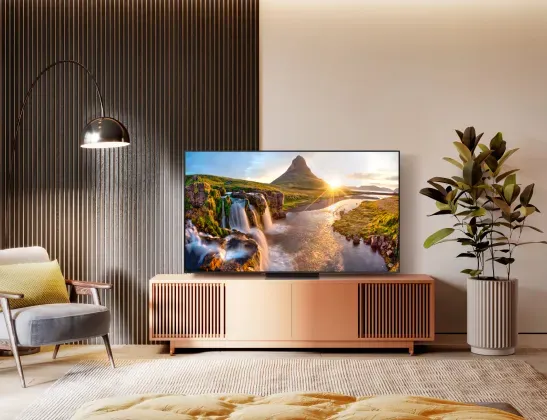
OLED vs QLED: Side-by-Side Comparison
Here’s what each technology offers, and where they fall short, across key performance dimensions:
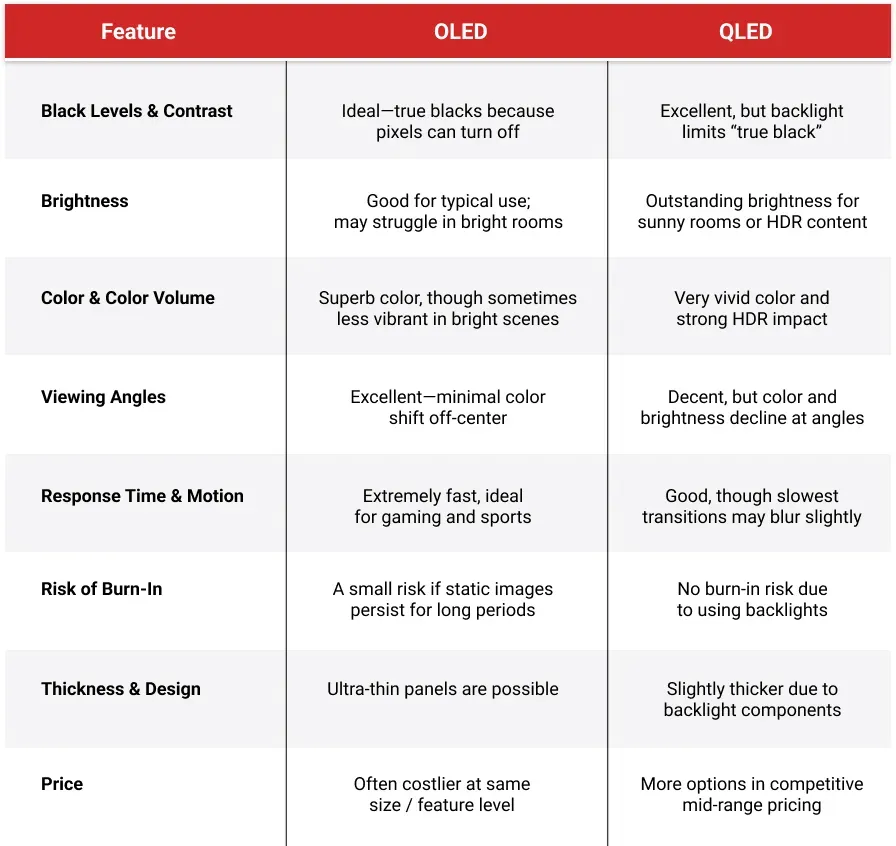
Advantages & Disadvantages: OLED vs QLED
Advantages of OLED
-
Supreme Contrast & Deep Blacks: For movie lovers and cinephiles, OLED’s black levels deliver scenes exactly as directors intended, with true darkness in shadows and no halo effects.
-
Wide Viewing Angles: Watching from the side? No problem, colors remain accurate and bright even from steep angles.
-
Fast Response for Gaming: Little input lag and near-instant pixel transitions make OLED ideal for fast-paced gaming or sports viewing.
-
Slim, Elegant Design: Without need for a backlight, OLED panels can be extremely thin and sleek, allowing wall-to-wall installations and near-frameless styles.
Drawbacks of OLED
-
Brightness Limitations: In very bright rooms or with intense HDR highlights, some OLEDs can’t compete with QLED’s peak brightness.
-
Potential for Burn-In: Static content (news tickers, HUDs in video games) can cause burn-in over years if displayed continuously.
-
Higher Price for Large Sizes: At very large screen sizes, OLED models often cost more than equivalent QLEDs.
Advantages of QLED
-
Superior Brightness: QLED’s LED backlight systems can achieve extremely high peak brightness, making them ideal in bright rooms or for outdoor light exposure.
-
Vivid HDR & Color Pop: Quantum dots enhance color saturation and volume, especially in bright scenes, HDR visuals really look eye-catching.
-
No Burn-In Risk: Because the display uses a backlight rather than organic pixels, burn-in is not a concern, even with static content over time.
-
Broader Price Range: You’ll find many QLEDs at competitive price points and in larger sizes without the premium jump that comes with OLED.
Drawbacks of QLED
-
Black Levels & Contrast Limitations: Even advanced local dimming cannot match OLED’s pixel-level control for perfect blacks.
-
Viewing Angle Fall-Off: When viewed from the side, QLEDs can show color and brightness degradation.
-
Greater Bulk: Backlighting and dimming zones make panels thicker than OLED; integration into slim cabinetry is more challenging.
Which One Is Best for You?
Choosing between OLED and QLED depends largely on your room conditions, use patterns, and priorities. Here’s how to decide:
Room Brightness & Lighting Conditions
-
If your living room has large windows or high ambient light, QLED’s brightness advantage may be crucial.
-
In darker rooms or dedicated home theater setups, OLED’s superior contrast becomes more noticeable.
Viewing Habits & Content
-
Cinephiles or fans of dark, cinematic visuals may prefer OLED for its realism in black levels.
-
Sports fans or gamers may benefit more from QLED’s brightness and color vibrancy.
-
Static content users (news, gaming HUDs) might prefer QLED to avoid burn-in risks.
Screen Size & Budget
-
OLED costs rise steeply at larger sizes; QLED often gives “bigger screen for the dollar.”
-
If your budget is moderate, QLED offers strong performance without OLED's premium markup.
Viewing Angles & Seating Layout
-
If your seating is spread wide across a room, OLED’s better off-axis picture makes it favorable.
-
If viewing is mostly from head-on, QLED’s fall-off might not be a major issue.
Tips for Shopping OLED or QLED TVs
-
Bring your own content (your favorite movie or game) to demo. How does black look? How bright does it get?
-
Test for uniformity: look at gray or black screens to spot blooming, clouding, or uneven dimming.
-
Ask about burn-in prevention features or warranties for OLED models.
-
Review refresh rates (120Hz or greater is ideal for gaming).
-
Consider hybrid OLED + dimming tech (some new models incorporate mini-LED backlights behind OLED panels).
Best OLED TVs to Consider
55-Inch Class LG OLED evo AI G5 4K Smart TV
-
4K OLED evo Display: Delivers perfect blacks, vibrant colors, and exceptional brightness with the Brightness Booster Ultimate for an immersive viewing experience.
-
Smart Entertainment Hub: Powered by the α11 AI Processor Gen2, featuring AI Picture Pro and AI Super Upscaling, plus support for Dolby Vision®, Dolby Atmos®, and FILMMAKER MODE™.
-
Sleek & Modern Design: Designed for wall-mounting with a flush, gallery-style aesthetic, complemented by the included wall mount for easy installation.
65-Inch Class LG OLED evo AI C5 4K Smart TV
-
4K OLED evo Display: Delivers perfect blacks, vibrant colors, and exceptional brightness with the Brightness Booster for an immersive viewing experience.
-
Smart Entertainment Hub: Powered by the α9 AI Processor Gen8, featuring AI Picture Pro and AI Super Upscaling, plus support for Dolby Vision®, Dolby Atmos®, and FILMMAKER MODE™.
-
Sleek & Modern Design: Slim bezel and stylish finish make it easy to integrate into any living space with a contemporary look.

Best QLED TVs to Consider:
65" Class Neo QLED 4K QN90F Samsung Vision AI Smart TV
-
4K Neo QLED: Experience ultra-bright, vivid colors and deep contrasts with Quantum Matrix Technology and Quantum HDR 32X for lifelike picture quality.
-
Next-Level Gaming & Performance: 120Hz refresh rate, AMD FreeSync Premium Pro, and low input lag deliver a seamless gaming and streaming experience.
-
Elegant, Minimalist Design: Ultra-slim profile with a clean One Connect box setup ensures a clutter-free installation and modern aesthetic.
55-Inch Class LG QNED82 4K Smart TV
-
4K QNED Display: Combines Quantum Dot and NanoCell technology for vibrant colors, deep contrast, and sharp, detailed images for all your favorite movies and shows.
-
Smart Entertainment Hub: Powered by webOS 25 with the α7 AI Processor Gen8 for AI-enhanced picture and sound, plus easy access to streaming apps and voice control.
-
Sleek & Modern Design: Slim bezel and stylish finish make it easy to integrate into any living space with a contemporary look.

Discover OLED and QLED TVs at Silica
Ready to experience the stunning visuals of OLED or QLED in person? Visit Silica to see side-by-side demonstrations and get hands-on with models from leading brands like LG, Samsung, and more. Our experts can help you choose the technology that fits your viewing habits, room, and budget.
Experience personalized expert advice, and professional installation services to help you find the perfect range for the holidays. Stop by one of our stores today in Fond du Lac, Beaver Dam, and Watertown, WI, and let our team guide you toward a range that’s ready to handle every celebration.
Related readings from our blog:
FAQs: OLED vs QLED TVs: Pros and Cons
Is OLED better than QLED in all cases?
No, while OLED offers unbeatable contrast, QLED may be better for bright rooms, large sizes, or users concerned about static content.
Can QLED match OLED black levels with local dimming?
QLED’s local dimming has improved, but even top-tier implementations can’t fully match OLED’s pixel-level control for perfect blacks.
Does burn-in still occur on OLEDs?
Yes, though modern OLEDs mitigate this with pixel-shifting, screen savers, and automatic adjustments. Prolonged static images can still risk burn-in over years.
Do smart features differ between OLED and QLED?
Not necessarily, smart functionality is driven by the operating system (webOS, Tizen, etc.), not display technology. Many OLED and QLED models share similar software features.
Will OLED get brighter over time?
No, OLED peak brightness generally declines slowly over the years, but good units retain excellent performance for a long life with proper use.
Related Articles