
OLED vs QLED: Pros and Cons
Fri Jul 24 2026
- Electronics
Buying a new TV has become more complicated than simply choosing a screen size. Today's premium televisions feature advanced display technologies designed for different viewing preferences, room conditions, and budgets. One of the biggest decisions shoppers face is choosing between OLED vs. QLED TVs.
So, which is better?
The answer depends on how, and where, you watch TV. If you love movie nights in a dark room, OLED may deliver the cinematic experience you're after. If your living room gets plenty of natural light or you're looking for the biggest screen for your budget, QLED could be the better investment.
At Silica, our TV experts help Wisconsin homeowners compare today's latest television technologies every day. In this guide, we'll explain the differences between OLED and QLED, discuss newer technologies like Mini LED and QD-OLED, and help you determine which TV best fits your viewing habits.
Key Takeaways: OLED & QLED: Pros and Cons
-
OLED TVs deliver perfect blacks, outstanding contrast, and wide viewing angles, making them ideal for movies, premium home theaters, and immersive gaming.
-
QLED TVs provide exceptional brightness, vibrant colors, and excellent value, making them a great choice for bright rooms, sports, and everyday family viewing.
-
Mini LED improves traditional QLED performance by increasing brightness and local dimming precision, while QD-OLED combines OLED's perfect contrast with even brighter, more vibrant colors.
-
The best TV isn't simply OLED or QLED, it's the one that best matches your room, viewing habits, and budget.
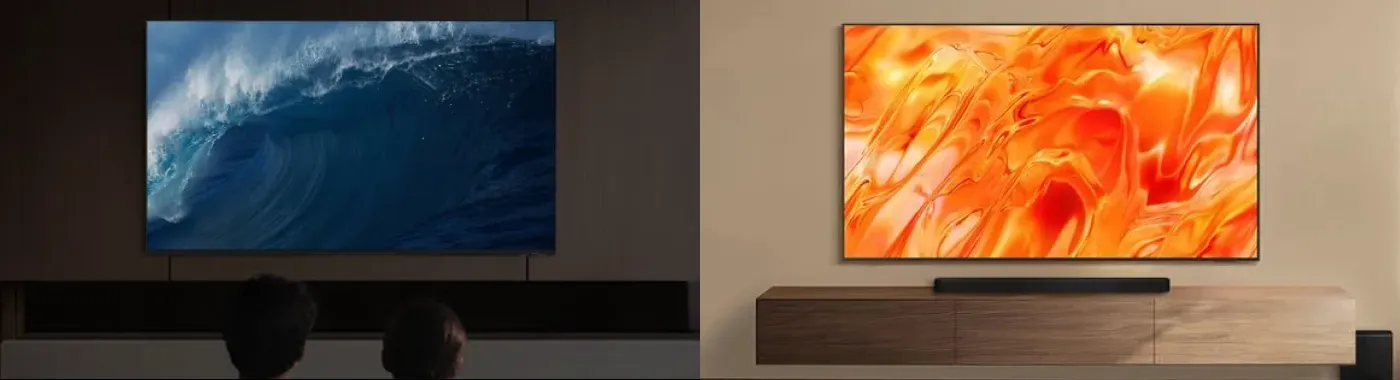
OLED vs. QLED: What's the Difference?
Although both technologies produce stunning picture quality, they work very differently.
OLED TVs
OLED stands for Organic Light-Emitting Diode. Unlike traditional LED televisions, every individual pixel produces its own light. Because each pixel can turn completely off, OLED displays produce true black levels with virtually infinite contrast.
This creates an incredibly realistic image with exceptional shadow detail and outstanding picture depth.
QLED TVs
QLED stands for Quantum Dot LED. These televisions still use an LED backlight, but they incorporate Quantum Dot technology to produce brighter images and more vibrant colors.
Because they rely on a backlight instead of self-lit pixels, QLED TVs cannot produce the same perfect black levels as OLED. However, they typically achieve much higher peak brightness, making them excellent performers in sunny rooms.
OLED vs. QLED Comparison Chart
| Feature | OLED TVs | QLED TVs |
|---|---|---|
| Picture Quality | Self-lit pixels create exceptional contrast and cinematic image quality | Excellent picture quality with bright, vibrant colors |
| Black Levels | Perfect blacks with virtually infinite contrast | Very good blacks, though backlighting may produce slight blooming |
| Brightness | Excellent, but lower peak brightness than premium QLED models | Outstanding brightness, ideal for high-ambient-light rooms |
| Color Accuracy | Extremely accurate and natural colors | Rich, saturated colors with high brightness |
| Viewing Angles | Excellent, image quality remains consistent from almost any seat | Good to very good, depending on the panel technology |
| Gaming Performance | Outstanding response times, low input lag, HDMI 2.1 support, VRR | Excellent gaming performance with HDMI 2.1 and high refresh rates on many models |
| Sports & Fast Motion | Smooth motion with minimal blur | Excellent motion handling, especially on brighter screens |
| Risk of Burn-In | Minimal with modern TVs and built-in protection features, though possible with prolonged static images | No burn-in risk |
| Energy Efficiency | Efficient for darker content; power usage varies by image | Consistent energy usage regardless of displayed content |
| Typical Price | Higher premium investment | Wider range of price points from mid-range to premium |
Who is OLED Best For?
One of the reasons OLED televisions continue to receive top marks from reviewers is their ability to reproduce images exactly as filmmakers intended.
OLED is often the better choice if you:
-
Watch lots of movies
-
Enjoy cinematic home theater experiences
-
Frequently stream HDR content
-
Play next-generation video games
-
Watch TV in darker rooms
-
Appreciate premium picture quality
Because every pixel controls its own illumination, dark scenes reveal significantly more detail than traditional LED televisions. Whether you're watching dramatic films, nature documentaries, or prestige television series, OLED creates exceptional realism.
Who is QLED Best For?
QLED televisions shine, literally, in bright environments.
They're an excellent option for homeowners who:
-
Watch TV in rooms with large windows
-
Watch sports throughout the day
-
Want a larger screen without paying OLED prices
-
Prefer extremely bright HDR performance
-
Need a television for everyday family viewing
The extra brightness helps reduce glare while maintaining vibrant colors, making QLED TVs especially popular for open-concept living rooms.
OLED vs. QLED for Gaming
Both technologies have become outstanding gaming displays, especially with today's gaming consoles and high-end gaming PCs.
OLED TV Gaming Advantages
Gamers often gravitate toward OLED because of:
-
Near-instant pixel response times
-
Outstanding HDR contrast
-
Deep blacks during dark gameplay
-
Minimal motion blur
-
Excellent input lag performance
Fast-paced shooters and cinematic adventure games especially benefit from OLED's incredible picture quality.
QLED TV Gaming Advantages
QLED remains an excellent gaming option thanks to:
-
Higher sustained brightness
-
Excellent visibility in bright rooms
-
Large screen sizes at lower prices
-
Advanced gaming features on many premium models
For households where gaming happens during the day or in bright family rooms, QLED may actually provide a better overall experience.
OLED vs. QLED for Movies
If your goal is recreating a movie theater at home, OLED is generally considered the gold standard.
Dark scenes maintain incredible detail without blooming around bright objects, while HDR movies look exceptionally realistic thanks to infinite contrast.
If your movie room has controlled lighting, OLED is difficult to beat.
OLED vs. QLED for Sports
Sports fans often have different priorities than movie enthusiasts.
Bright stadium lighting, fast camera movement, and daytime viewing make QLED televisions particularly attractive.
Their higher brightness helps maintain image quality even when sunlight enters the room, while premium motion processing keeps fast-moving action smooth and clear.
For households that spend weekends watching football, baseball, basketball, or racing, QLED is often the more practical choice.
OLED vs. QLED for Bright Rooms
Room lighting can have a huge impact on television performance.
If your TV sits opposite large windows or receives substantial daylight throughout the day, QLED's superior brightness makes it easier to see the picture without raising blinds or dimming lights.
OLED performs beautifully in moderate lighting but reaches its full potential in darker viewing environments.
What About Mini LED and QD-OLED?
The TV industry has continued to evolve, introducing technologies that bridge the gap between traditional OLED and QLED displays.
Mini LED
Mini LED televisions are an evolution of traditional LED technology.
By using thousands of much smaller LEDs behind the screen, Mini LED TVs dramatically improve local dimming, contrast, and HDR performance while maintaining the outstanding brightness QLED is known for.
If you're shopping for a premium LED television, Mini LED models are worth serious consideration.
QD-OLED
QD-OLED combines Quantum Dot technology with OLED panels.
The result is a television capable of OLED's perfect blacks while delivering even brighter colors and higher color volume than traditional OLED displays.
For buyers seeking cutting-edge picture quality, QD-OLED represents one of the most advanced display technologies currently available.
Which TV Should You Buy?
If you're looking for the shortest possible answer:
Choose OLED if...
-
You prioritize picture quality above everything else.
-
You mostly watch movies or stream TV in darker rooms.
-
You want the best gaming experience available.
-
You appreciate premium home theater performance.
Choose QLED if...
-
Your TV is in a bright living room.
-
You watch lots of sports and daytime television.
-
You want exceptional performance at a wider range of price points.
-
You're looking for the largest screen possible within your budget.
Ultimately, both technologies produce stunning images. The better choice depends on how your family watches TV, not simply which technology has the most impressive specifications.
Recommended OLED TVs at Silica
If you're looking for premium OLED picture quality, consider these standout models available at Silica:
LG 55 Inch Class LG OLED evo AI C6 4K Smart TV (Model #: OLED55C6PUA)
The LG OLED55C6PUA delivers exceptional contrast, vibrant HDR performance, and advanced gaming features, making it an excellent choice for movie lovers and gamers alike.
Samsung 77 Inch Class OLED S90H 4K Samsung Vision AI Smart TV (Model #: QN77S90HAEXZA)
This Samsung QN77S90HAEXZA combines OLED technology with Quantum Dot enhancements for outstanding brightness, color accuracy, and immersive viewing across movies, sports, and gaming.
Recommended QLED TVs at Silica
For bright rooms and everyday family viewing, these QLED models provide outstanding value and performance.
LG 85 Inch Class LG QNED evo AI Mini LED QNED84B 4K Smart TV (Model #: 85QNED84BUA)
The LG 85QNED84BUA television combines Quantum Dot and NanoCell technologies with Mini LED backlighting to deliver impressive brightness, vivid colors, and excellent HDR performance. The expansive 85-inch display makes it a great option for large living rooms and sports enthusiasts.
Samsung 55 Inch Class Neo QLED QN70H 4K Samsung Vision AI Smart TV (Model #: QN55QN70HAFXZA)
Samsung's QN55QN70HAFXZA model offers strong brightness, rich color reproduction, and excellent everyday performance. It's an ideal choice for households that watch a mix of sports, TV shows, and movies in rooms with plenty of natural light.
Shop the Best OLED & QLED TVs at Silica
Whether you're upgrading your family room, building a dedicated home theater, or searching for the perfect gaming TV, Silica has the expertise to help you choose with confidence. Our team can explain the differences between OLED, QLED, Mini LED, and QD-OLED technology so you can find the television that best fits your viewing habits, room lighting, and budget.
Contact us today or visit our Silica store locations in Fond du Lac, Beaver Dam, and Watertown, Wisconsin, to experience today's latest television technology in person. You can also browse our complete selection of TVs online, compare features side by side, and speak with our knowledgeable experts to find the right entertainment solution for your home.
Related readings from our blog:
FAQs: OLED vs QLED: Pros and Cons
Is OLED better than QLED?
It depends on how and where you watch TV. OLED delivers superior contrast, perfect black levels, and wider viewing angles, making it an excellent choice for movie lovers and gamers. QLED offers higher brightness and outstanding daytime performance, making it ideal for bright family rooms. The better option ultimately depends on your viewing environment and priorities.
Which TV is better for gaming?
Both OLED and premium QLED TVs are excellent gaming choices. OLED offers near-instantaneous response times, exceptional contrast, and immersive HDR performance, while many QLED models provide extremely bright images and support features like 120Hz refresh rates, Variable Refresh Rate (VRR), and HDMI 2.1. Gamers should also consider screen size, room lighting, and console compatibility when choosing a TV.
Does OLED still have burn-in issues?
Modern OLED televisions include numerous technologies designed to minimize burn-in, such as pixel shifting, automatic brightness adjustments, and screen refresh functions. For most households watching varied content, burn-in is unlikely to become a problem during normal use. However, users who display static images for extended periods should still follow the manufacturer's recommendations.
Is QLED better for bright rooms?
Yes. QLED TVs are capable of producing significantly higher peak brightness than most OLED models, allowing them to combat glare and maintain vibrant picture quality in rooms with large windows or abundant natural light. This makes QLED an excellent choice for open-concept living spaces and daytime viewing.
Should I buy an OLED, QLED, Mini LED, or QD-OLED TV?
Each technology offers unique strengths depending on your viewing preferences and budget. OLED excels in dark-room movie viewing, QLED shines in bright spaces, Mini LED improves contrast and brightness over traditional LED TVs, and QD-OLED combines OLED's perfect blacks with enhanced brightness and color volume. Visiting a showroom to compare these technologies side by side can make it much easier to determine which one best fits your home.
Related Articles